
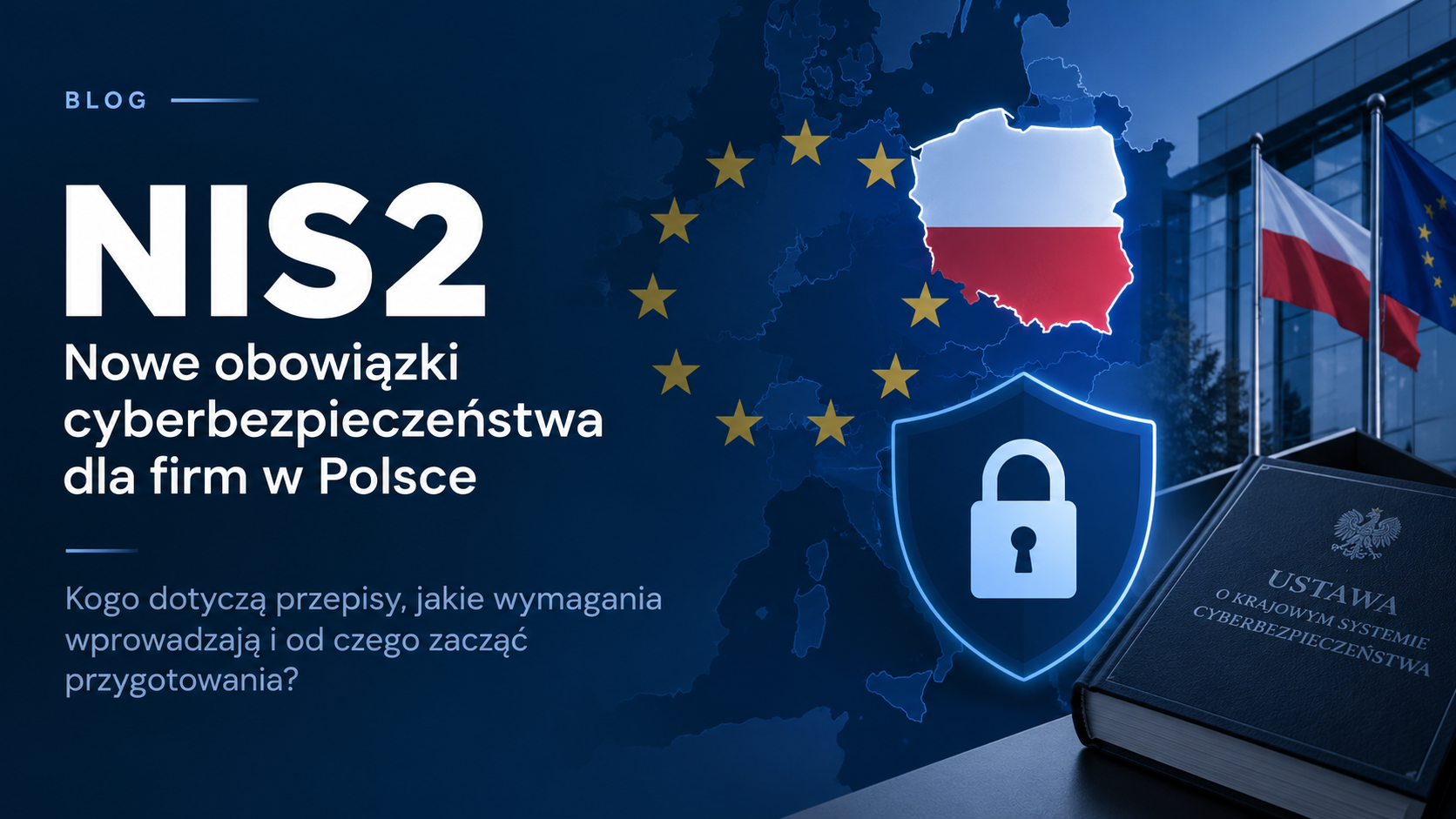
NIS2 (Network and Information Security Directive 2) is an EU cybersecurity directive designed to increase the level of cybersecurity across organisations that are important to the functioning of the economy, public services and society.
In Poland, NIS2 requirements were implemented through the amended National Cybersecurity System Act (KSC), which entered into force on 3 April 2026.
The change is significant because the new rules apply to many more organisations than the previous KSC framework. The former distinction between operators of essential services and digital service providers has been replaced by two main categories: essential entities and important entities.
NIS2 / KSC is not only about having security documentation. It requires real management of risk, incidents, suppliers, business continuity and IT system security.
Does NIS2 apply to your business?
Simply operating a business does not automatically mean that the organisation falls within the scope of the regulations. An organisation should first assess:
- the sector in which it operates,
- the type of services it provides,
- the size of the organisation,
- links with partner or associated enterprises,
- specific criteria defined in Article 5 of the Polish KSC Act.
This is important because qualification cannot be reduced to a simple rule such as “50 employees or EUR 10 million in turnover”. The rules for determining whether an organisation is a micro, small, medium-sized or large enterprise must be taken into account, and in certain cases partner and linked enterprises also need to be considered.
Some categories of entities may also fall within the scope of the KSC Act regardless of the standard company-size thresholds or under specific sector-based rules.
Which sectors are covered by NIS2 / KSC?
The amended KSC Act significantly expanded the range of sectors covered by the national cybersecurity framework.
Essential sectors include, among others:
- energy,
- transport,
- banking and financial market infrastructure,
- healthcare,
- drinking water,
- wastewater,
- digital infrastructure,
- electronic communications,
- ICT service management,
- space,
- selected public administration entities.
Important sectors include, among others:
- postal and courier services,
- waste management,
- manufacture and distribution of chemicals,
- food production and distribution,
- manufacture of selected industrial products and equipment,
- digital service providers,
- research organisations,
- selected public-sector entities.
The detailed scope follows from Annexes 1 and 2 and Article 5 of the KSC Act. Simply operating broadly within one of these industries is not always enough to determine whether an organisation is covered.
Essential entity or important entity?
The amended KSC Act distinguishes between two main categories: essential entities and important entities.
Classification depends on factors such as the sector, the size of the organisation and the type of activity carried out. Certain categories are also subject to specific rules independent of standard company-size thresholds.
The distinction matters, among other things, for supervisory mechanisms and audit obligations. However, both essential and important entities are required to implement a real cybersecurity management framework.
Key obligations under NIS2 / KSC
An organisation covered by the KSC Act cannot achieve compliance simply by purchasing a firewall, EDR platform or SIEM system. The new requirements apply to the broader way cybersecurity is managed across the organisation.
In practice, organisations need to address areas including:
- cybersecurity risk management and regular risk assessments,
- an Information Security Management System (ISMS),
- appropriate and proportionate technical and organisational security measures,
- incident management and reporting,
- supply-chain security and supplier assessment,
- business continuity and Disaster Recovery,
- backup and recovery capabilities,
- vulnerability and patch management,
- access control and identity security,
- security monitoring,
- clear cybersecurity responsibilities,
- training and involvement of management bodies.
KSC compliance is not about producing dozens of documents. An organisation should understand its risks, know who is responsible for them and know what will happen when preventive controls fail.
How does incident reporting work?
One of the most important obligations concerns the handling and reporting of significant incidents.
An essential or important entity should:
- submit an early warning within 24 hours of becoming aware of a significant incident,
- submit a formal incident notification within 72 hours,
- provide intermediate information on incident handling where required,
- submit a final report, generally within one month of the incident notification.
This means that an organisation needs more than a written procedure. It must be able to detect incidents, classify them, analyse their impact and escalate them quickly.
Supplier and supply-chain security
NIS2 / KSC places strong emphasis on risks arising from suppliers and third parties. An organisation may have well-secured internal systems and still be compromised through software, a cloud service, an external administrator or another provider with access to its infrastructure.
In practice, organisations should assess areas such as:
- the level of access suppliers have to systems and data,
- authentication methods and privileged-account controls,
- security requirements included in contracts,
- the supplier's ability to respond to incidents,
- service continuity,
- dependency on a single supplier or technology.
What if my company is not directly covered by KSC?
Not being directly subject to the KSC Act does not mean that NIS2 will have no impact on your organisation.
Essential and important entities are required to manage cybersecurity risks across their supply chains. As a result, they may impose security requirements on suppliers, contractors and service providers.
These requirements may include specific technical controls, incident-reporting obligations, access-control standards, contractual security clauses or audit rights.
This means that smaller IT providers, software companies, manufacturers and subcontractors may still encounter NIS2 / KSC requirements indirectly through their customers.
Important deadlines in 2026 and 2027
For entities that met the relevant criteria when the amended KSC Act entered into force, several dates are particularly important:
3 October 2026
Deadline for self-registration in the register of essential and important entities for organisations that are not entered automatically.
3 April 2027
End of the transitional period for entities that met the criteria when the amended Act entered into force. By this date, they should have implemented their obligations and started using the S46 system.
3 April 2028
Deadline for the first mandatory audit for certain essential entities that were not previously classified as operators of essential services.
The KSC register and the S46 system
Organisations covered by the Act are included in the register of essential and important entities.
The S46 system is used, among other things, for communication with entities within the national cybersecurity system and for fulfilling incident-reporting obligations.
In many cases, an organisation should not expect to receive an individual administrative decision confirming that it falls within the scope of the KSC Act. One of the first tasks is therefore self-identification and determining whether the statutory criteria are met.
What are the consequences of non-compliance?
The KSC Act provides for supervisory measures, inspections and financial penalties. The level of a penalty depends, among other things, on the category of entity, the type of violation and its severity.
For businesses, the maximum penalty levels may reach:
- for essential entities — up to EUR 10 million or 2% of revenue, subject to the rules defined in the Act,
- for important entities — up to EUR 7 million or 1.4% of revenue, subject to the rules defined in the Act.
The regulations also provide for management responsibility in certain circumstances.
In practice, organisations may also face commercial consequences such as losing a contract, failing a customer security assessment or being unable to meet the security requirements of a key business partner.
Where should you start with NIS2 / KSC?
The first step should not be buying another cybersecurity product.
It is better to begin by answering a few fundamental questions:
- Does the organisation fall within the scope of KSC? — analyse sector, activity and company size.
- What is already in place? — assess existing controls, processes and documentation.
- Where are the main gaps? — perform a Gap Analysis against KSC requirements.
- What are the key risks? — identify assets, threats, vulnerabilities and potential business impact.
- What should be done first? — prepare an implementation roadmap.
Only then does it make sense to build or update the ISMS, procedures, monitoring, backup, network security, identity management and other technical safeguards.
NIS2 / KSC is best treated as a resilience programme, not only as a regulatory compliance project.
Does the company need to replace its entire infrastructure?
No. The new regulations do not automatically mean that an organisation needs to buy new firewalls, SIEM or EDR systems, or replace its entire infrastructure.
Security measures should be appropriate to the level of risk, the size of the organisation, the systems being used and the importance of the services being provided.
In many cases, the right first step is to improve what already exists: privileged access, backup, network segmentation, patching, monitoring, documentation and clearly defined responsibilities.
How can we help?
sLogic Group helps organisations move from the question “Does KSC apply to us?” to a concrete cybersecurity model and implementation plan.
The scope can include technical self-identification support, Gap Analysis, risk assessment, ISMS preparation, an implementation roadmap and deployment of practical organisational and technical safeguards.
You can learn more about our NIS2 / KSC Compliance for Businesses in Poland service. If you first need an independent assessment of your current environment, you can also start with an IT Audit and Architecture.
Not sure whether your organisation falls within the scope of KSC?
Start by defining the scope, performing a Gap Analysis and assessing your current cybersecurity posture. That is a much better starting point than implementing random security tools.